

Why you should see Palestine 36, and not applaud NAZA
Tawfiq Al-Ghussein and Rania Hammad
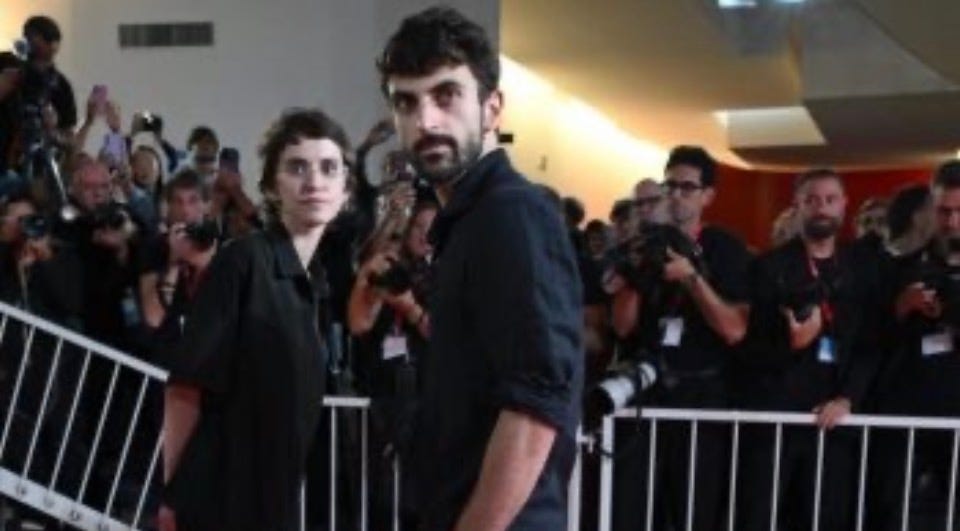
At the Venice Film Festival a hall rose to its feet and applauded for twenty-five minutes. It was the longest ovation in the festival’s history. The year before, the record was twenty-three minutes, and it too belonged to a film about Gaza: The Voice of Hind Rajab, built around the last phone call of a Palestinian child trapped in a car under fire. The two longest ovations Venice has ever given both concern Gaza. The longer one, though, is not for the child’s voice. It is for NAZA, a documentary in which Israeli intelligence officers and soldiers, their faces hidden, describe how Gaza was turned into a system of targets, of scores, of civilian deaths calculated in advance. The title itself is a term the Israeli military used for the number of civilians a single strike was expected to kill.
It is worth pausing here, before we talk about the film.
For almost three years Palestinians in Gaza have documented their own destruction in real time. They filmed the bombs as they fell, the children pulled from the rubble, the hospitals collapsing around the doctors, the journalists killed as they worked. Fathers and mothers turned their cameras on the bodies of their own children. They filmed themselves starving, fleeing, returning, digging, burying. It is hard to imagine the destruction of a people documented more fully than this, and not only since October 2023, but for decades. And still it was not enough. It never is. Only when an Israeli speaks does the room stand.
Why does the truth change status when an Israeli is the one to speak it? Why is what a Palestinian says from his own ruined home treated as partisan testimony, while the same thing said by someone inside the apparatus that produced that destruction becomes a revelation?
The Palestinian poet Mohammed El-Kurd has given this mechanism a name. In what he calls the politics of appeal, he describes the condition imposed on Palestinians: to be heard, they must appeal to the conscience of those who oppress them, prove their own innocence, present themselves as perfect victims. Victims without anger, without politics, without resistance. Anyone who does not fit that image loses the right to be believed. It is a trap, because on that ground the Palestinian never wins. If he speaks, he is biased. If he accuses, he exaggerates. If he resists, he justifies what is done to him. His word, on its own, is never enough. Someone else must always vouch for it.
The Israeli witness solves exactly this problem. The Palestinian asked to be believed and it was not enough. The Israeli asks for nothing: he confirms. And in confirming he offers the Western viewer what he really needs, the chance to believe the atrocity without having to believe the Palestinian.
The Palestinian journalist Mahmoud Mushtaha, who sat through NAZA in the cinema, called the twenty-five-minute ovation an indictment of a Western media that had spent three years treating Palestinian journalists as “unreliable narrators of our own deaths.” He is glad, he wrote, that the testimony is believed now; but belief that arrives this late, at this cost, is not safety.
The Palestinian writer Susan Abulhawa put it bluntly: “Palestinians have given their lives to tell this story. Inside and outside Gaza we have screamed to the world what Israel was doing, as we have screamed for decades. But only Israelis are believed, celebrated as courageous narrators, while the perpetrators are humanised and given the benefit of the doubt.”
That is the point. Not only that Palestinian testimony is ignored, but that Israeli confirmation is granted a moral value the Palestinian word is never allowed. A Palestinian tells you his family was killed, and he is a victim. An Israeli tells you that Palestinians were knowingly killed, and he becomes brave. The Palestinian supplies the body. The Israeli supplies the revelation.
We already know this device. In Israel there is even a phrase for one of its forms, yorim ve-bochim, “shooting and crying.” The soldier shoots, then weeps for what he has done, and the weeping becomes the proof that he has kept his humanity. The crime can be acknowledged, so long as what returns to the centre of the story is the conscience of the person who took part in it.
There is a second side to this, turned toward Israel itself. If it is Israelis who denounce Israeli crimes, then perhaps Israel remains, underneath all of it, the liberal, self-correcting society its defenders have always described. Look, we are told: Israeli directors denounce the army, Israeli soldiers confess, Israeli society argues with itself. There must be another Israel, decent, tormented. The dissident becomes evidence for the defence. This is the deepest function of “shooting and crying”: the tears do not put the system in question, they save its moral image. And today, after what the world has seen in Gaza, Israel needs that image desperately.
In NAZA the men do not even weep. They describe the killing in flat voices, one of them likening it to a video game. The remorse is never on the screen. It is supplied by the room, by an audience that needs to believe someone up there is troubled.
The Palestinian-American journalist Ali Abunimah put the question with the hardness it requires: why do men who describe crimes of this gravity become the anonymous protagonists of a cultural consecration, instead of being called to answer for them?
Anonymity may be necessary to obtain testimony. Journalists protect their sources, whistleblowers run real risks. But anonymity cannot become absolution. If someone tells you he took part in a system in which entire families were knowingly killed, we have the right to ask for more than his discomfort. What did he do? What did he authorise? Who died? Will he hand the evidence to investigators, the names to prosecutors? Will he appear before a court? Otherwise what remains is a reversed moral transaction: the Palestinian victim is identified, photographed and buried; the Israeli participant stays anonymous, protected, and is then praised for telling us that the victim is dead.
And here something has to be said that no one in Venice said. NAZA is by Yuval Abraham and Rachel Szor, the same two who made No Other Land together with the Palestinians Basel Adra and Hamdan Ballal. They are not hasbara propagandists. They are the sincere, anti-occupation Israelis, the “good Israelis” this whole argument is about. And it is their own story that shows the asymmetry in its rawest form. Weeks after the four of them won the Oscar together, settlers attacked Ballal in his village of Susiya, in the West Bank, leaving his head bleeding, and the army took him away and held him overnight. Adra said that since they came back from the Oscars there had been an attack every day, and that it felt like revenge. The Israeli directors collect the ovation and the Special Jury Prize; their Palestinian co-director is beaten on his own land. Same film, same podium, unequal bodies.
The brave-dissident frame deserves a closer look too. Israel’s culture minister called for Abraham and Szor to be stripped of their citizenship. And yet, in Venice, it is the Western audience that rises to its feet, for the Israeli voice.
None of this makes the testimony worthless. It must be preserved, verified, brought before a court, and on what it proves, sanctions and accountability must be demanded. El-Kurd himself acknowledges what NAZA lays bare: the automated, institutional nature of the killing, the mass death of civilians “by design,” the Lavender system that selects the targets. The revelations about AI-assisted targeting strip Western governments of the alibi of plausible deniability. And the film has real value, because it reaches an audience Palestinians have too often been unable to reach.
But if that audience leaves the cinema reassured that “good Israelis” exist, instead of confronted with the system, then the film has failed exactly where it mattered most. Do not confuse confirmation with discovery. Do not confuse confession with courage. Do not confuse remorse with justice.
There is also a question of time. NAZA begins where the war begins. Built on the words of soldiers describing the targeting system, it can only open after 7 October. And in that opening it silently accepts the frame we should refuse: that the story starts there, that 1936, the Nakba and the decades of occupation are backdrop and not cause.
This is exactly why Palestine 36 matters.
Annemarie Jacir’s film does the opposite. It does not need the Israeli conscience to open the door to Palestinian history. It takes us into 1936, inside a Palestinian society facing British colonial rule, dispossession and a gathering catastrophe. Jacir worked on it for close to ten years. The film was built by Palestinian hands, and it is the only feature shot in Palestine during these two years of war. There is one scene she fought to keep at all costs: a girl running along the walls of Jerusalem. It is worth more than any thesis.
Palestinians stand at the centre of their own story. They are not evidence in someone else’s moral journey, they do not wait for an Israeli to confirm what they know about their own country. They speak before Israel even exists. And that alone breaks one of the most stubborn habits in the way Palestine is presented to a Western audience: Palestinians have a history before Israeli remorse, a politics before Israeli dissent, a memory before Israeli confession.
Go and see Palestine 36. Not as a gesture of cultural solidarity, not because Palestinian cinema should be placed above criticism, not because a film can undo decades of erasure. Go because it matters who tells the story. Go because Palestinians have been supporting characters in Israel’s moral biography long enough. Go because a people should not have to die in front of a camera and then wait for someone belonging to the society that is killing them to explain to the world that those deaths were real.
And when the Israeli soldiers speak, listen to them. Keep the evidence, verify it, take it to court. But do not mistake confirmation for discovery.
The Palestinian poet Mosab Abu Toha, who lost his own family to these strikes, wrote what needed to be said about the applause. He listed the dead by name and by number: his father’s cousin, killed with his wife, his children and his grandchildren, thirty-one people in a single strike; more than ninety of the Joha family in another. Then he turned to the confessions. “You need to break the bones of the system behind this evil,” he wrote. “Break the warplanes. Break the tanks. Break the artillery. You need a revolution, not merely a breaking of the silence.”
That is the distinction. We are applauding the breaking of the silence when what is needed is the breaking of the system. And the silence was never theirs to break first. Palestinians spoke long before them, and it is Palestinian voices we should be listening to.
The question is no longer whether good Israelis exist. It is why Palestinians must keep dying before the world is willing to believe them. And why, when an Israeli finally repeats what the dead had been telling us all along, the world rises to its feet and applauds for twenty-five minutes.
Agree, you bring an essential perspective I had failed to recognize. That only Israeli reporting, however contrite, is viewed as the true authority in Gaza, despite the endless reporting by Palestinians, often massacred for speaking out, is too shameful to comprehend. The bias permeates all govts, legislation, media access & distribution, never benefitting the Palestinian voices who are the true truth-tellers, attempting to expose their lived/shared experiencing. So damn unfair, but nothing has ever been fair for the Palestinian people. I pray, someday soon, we will see a recognition & people worldwide will join you, support you & hear your stories, validating what has been & continues to be done. Unacceptable, yet the world now sees & still action supressed, those blindly supporting the Zionists need to be exposed & punished. This is so damn undeserved, Palestinian voices must be valued!Where can this alternative film be seen?
Spot on, Tawfiq. Why do people believe Israelis more? That question has been bothering me for years. My latest piece on mental colonization addresses that
https://ramseyhanhan.substack.com/p/decolonize-your-mind-part-23-authority?r=29waq2&utm_medium=ios