


Palestine Had a Football Team. Palestinians Were Not Allowed to Represent It.
In the 1930s an association run by the Zionist sporting movement held FIFA’s licence to represent Palestine, and the Arab majority was shut out of the national team. FIFA’s choices then, and its refusal this year to act on Israeli settlement clubs, show how an international body can protect an existing arrangement and call it neutrality.
On 16 March 1934 a team called Palestine walked onto the British Army ground in Cairo to play Egypt in a qualifier for that summer’s World Cup in Mussolini’s Italy. Egypt won 7–1. Three weeks later the return leg in Tel Aviv ended 4–1 to Egypt, who went on to Italy as the first African side ever to play at a World Cup. The team that lost both matches carried the name of a country whose population, according to the British census of 1931, was more than four-fifths Arab. Every player on it was Jewish.
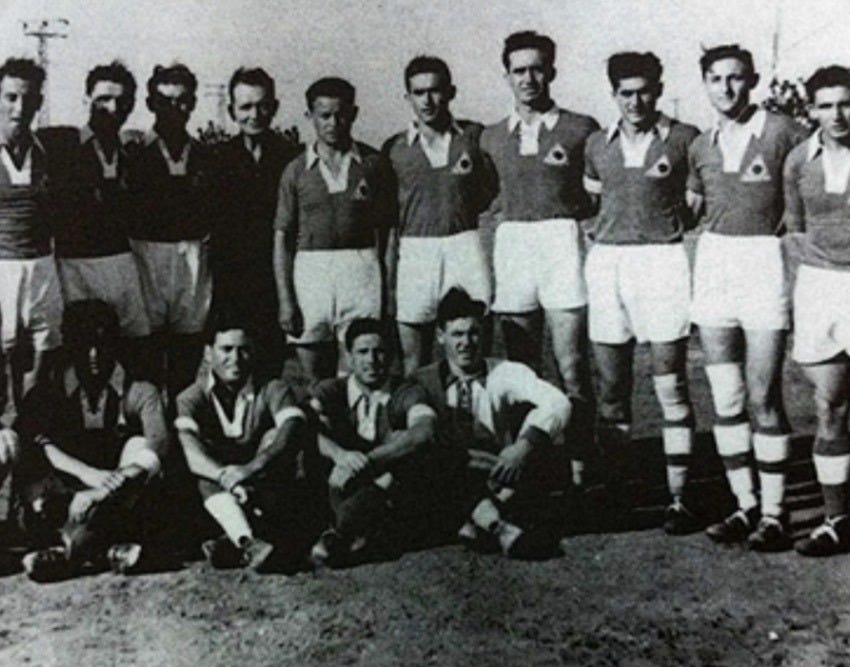
The Mandatory Palestine team before its friendly match against Lebanon in Tel Aviv, 27 April 1940, its last international before 1948. Photograph: Israel Football Association archive, via Wikimedia Commons (public domain).
Al Jazeera World’s documentary Palestine: The Lost Team, released on 7 October, tells this story through archive material and interviews with historians. It deserves an audience. It also raises a question that reaches beyond sport, because the institution at the centre of the story did something more lasting than lose two football matches. It took possession of the country’s name, and an international body let it keep it.
The Palestine Football Association was founded in 1928 at the initiative of Yosef Yekutieli of the Maccabi sporting movement, and FIFA admitted it the following year. FIFA’s rules shaped the design. FIFA accepted associations that governed football in a territory. It did not accept associations that spoke for one community within it. A body calling itself Palestinian and claiming the whole country could join, and so a handful of Arab clubs were brought in, enough to meet the requirement.
They did not stay long. The historian Issam Khalidi has documented how the association’s leadership kept Jewish clubs in the majority, conducted its business in Hebrew and put a Zionist emblem into its insignia. By 1934 the Arab clubs had walked out. The side that travelled to Cairo that March, and the one that lost to Greece in qualifying for the 1938 World Cup, was selected by an association in which the Arab majority had no say.
Palestinian Arabs had plenty of football of their own. There were clubs in Jaffa, Haifa, Jerusalem and the towns between them, an Arab sports federation founded in 1931 and revived in 1944, and an Arab league that Shabab al-Arab of Haifa won in 1946 and again in 1947. What the Arab federation lacked was the FIFA licence. Without it, even arranging matches with neighbouring Arab associations bound by FIFA’s rules was difficult. The body that held the licence decided, in practice, who could play whom.
The Arab federation tried to change this through FIFA’s own procedures. In 1946 it submitted a memorandum asking for separate recognition, arguing that Arab and Jewish football in Palestine could no longer be run by one association. The question came before FIFA’s congress in Luxembourg that summer. The federation’s secretary-general, Abd al-Rahman al-Habbab, was due to attend. According to research published in the Jerusalem Quarterly (issue 101), he was refused admission, for reasons that remain unclear. The Palestine Football Association’s representative told the congress that there were only four or five Arab clubs in Palestine. FIFA left the arrangement as it was.
That claim is the heart of the story. By 1946 Palestine was about two-thirds Arab, and the Arab federation was running a league that Shabab al-Arab of Haifa won that year. The association that had pushed Arab clubs out now told world football that Arab football barely existed, at a meeting from which the Arab federation’s own representative had been kept away. Once recognised, the association could describe Palestinian football to FIFA with no one in the room to contradict it.
Football did not invent this pattern. The Mandate for Palestine, confirmed by the League of Nations in 1922, wrote the establishment of a Jewish national home into its preamble and, in Article 4, recognised a Jewish agency as a public body to advise and cooperate with the British administration. It created nothing comparable for the Arab majority, whom the preamble described only as the “existing non-Jewish communities”. When Britain offered an Arab agency in 1923, Palestinian leaders turned it down, because accepting it on those terms meant accepting the Mandate that had made them a footnote in their own country.
A football association is not a government, and FIFA membership was never recognition of sovereignty. The comparison holds at the level of structure. In both cases an international body gave one community’s institution standing to act for the whole country, and then treated the majority’s objections as a procedural matter that the existing arrangement had already settled.
The structure outlived the Mandate. In 1948 the Palestine Football Association became the Israel Football Association and carried its FIFA membership into the new state. The five international matches played under the Mandate between 1934 and 1940 now appear in the record books as Israel’s first internationals. The Arab federation did not survive the Nakba. Its strongest clubs were in Jaffa and Haifa, and their players and supporters were driven out along with most of the Arab population of both cities. Palestinians rebuilt their football in exile and under occupation, and on 8 June 1998, at FIFA’s congress in Paris, Palestine was admitted as a member in its own right, seventy years after an association bearing its name had been founded without it.
This could be read as a closed chapter, an injustice of the colonial era since corrected. FIFA’s conduct this year argues against that reading.
On 19 March 2026, after the Palestinian Football Association had pressed the matter for some fifteen years, the FIFA Council decided to take no action over Israeli clubs based in West Bank settlements that play in Israel Football Association competitions. Amnesty International counts at least six such clubs; the Palestinian association puts the figure higher. FIFA’s statutes forbid a member association from organising football on another member’s territory without its consent. The Council declined to apply that rule because, in its view, the legal status of the West Bank remains an unresolved and highly complex matter under public international law. On the same day FIFA fined the Israeli association for discrimination.
The International Court of Justice had already addressed the legal status that FIFA called unresolved. In its advisory opinion of July 2024 the court found that Israel’s continued presence in the occupied Palestinian territory is unlawful and that the settlements breach international law. FIFA nevertheless declined to act, relying on a claim of legal uncertainty despite the court’s findings. The Palestinian association has since taken the case to the Court of Arbitration for Sport, where it is pending, and its delegates spent the run-up to this year’s FIFA congress in Vancouver arguing about visas.
The parallel with 1946 is exact enough to be uncomfortable. Then, FIFA was told that its Palestinian member did not speak for most Palestinians, and it kept the arrangement. Now it has been told that its Israeli member runs league football on land the world court says Israel must leave, and it has kept that arrangement too, citing uncertainty over a question the court has answered. On both occasions FIFA presented inaction as neutrality, and on both occasions inaction worked in favour of the institution already in possession.
Membership has given Palestinians a seat in world football. It has not given them control of the conditions in which they play. Players from Gaza and the West Bank need Israeli permission to train together or travel abroad. The domestic league has been repeatedly suspended. Gaza’s grounds have been bombed or put to other uses during the war, and many of its players have been killed. Membership has also not stopped another association from running fixtures in the West Bank, inside the territory that FIFA itself recognises as the Palestinian association’s.
Palestinian political life has the same gap between standing and control, on a far larger scale. More than three quarters of the world’s states now recognise the State of Palestine, while the Palestinian Authority administers parts of the occupied territory without control of its borders, its movement, its water or its security. The football association of 1928 is not an ancestor of the Oslo arrangements, and the history should not be forced into that shape. What links them is the habit of treating recognition as though it were self-determination.
None of this is an argument against the players who took the field in Cairo, who did not design the system that selected them, or against the long history of Jewish football in Palestine, which is real. It concerns the claim to represent a whole people by a body most of that people had no part in, and the conduct of the international institution that accepted the claim and then defended it.
In 1934 the name Palestine was on the team sheet and the Palestinians were not. In 1998 they finally got a team of their own. In 2026 they are in Lausanne, asking a court of arbitration to stop another country’s football association from playing on their land, because FIFA would not.
Recognition was never the same as sovereignty. Twice, when the gap between the two in Palestine was put before it, FIFA chose to leave it open.
Yes like the South African apartheid teams made up of white Europeans too.